
Creosote and Chimney Fire Risk: What You Need to Know
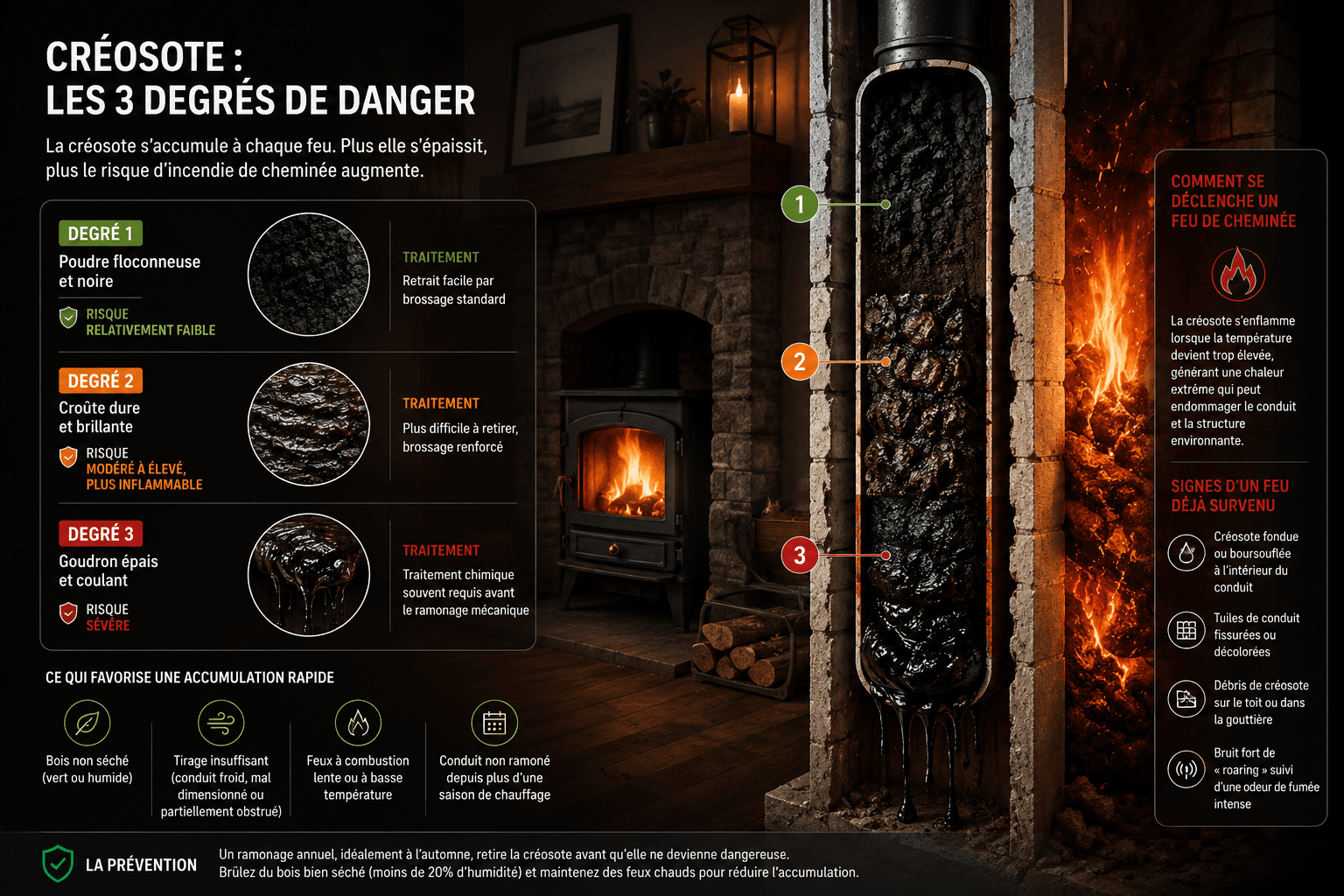
Every time you burn wood, the smoke rising through the flue carries unburned particles, water vapor, and chemical compounds. As it cools against the colder flue walls, this condenses into creosote — a substance that can be as flammable as the wood itself, and that builds up silently, fire after fire, never showing itself until a sweep inspects it or it ignites.
The three grades of creosote
| Grade | Appearance | Risk | Treatment |
|---|---|---|---|
| Grade 1 | Flaky black powder | Relatively low | Easy removal with standard brushing |
| Grade 2 | Hard, shiny crust | Moderate to high, more flammable | Harder to remove, reinforced brushing |
| Grade 3 | Thick, dripping tar | Severe | Chemical treatment often needed before mechanical sweeping |
Grade 2 typically forms when wood burns at low temperature or draft is insufficient — conditions that prevent complete combustion and promote condensation of more concentrated residue. Grade 3, the most dangerous, generally results from prolonged buildup without maintenance, often across several seasons.
What accelerates buildup
- Burning unseasoned (green or wet) wood, which produces more smoke and unburned residue
- Insufficient draft, often caused by a flue that's too cold, poorly sized, or partially obstructed
- Slow-burning or low-temperature fires, which don't fully burn off the compounds that form creosote
- A flue that hasn't been swept in over a full heating season
How a chimney fire starts
When accumulated creosote reaches a high enough temperature — often during a particularly hot fire following several milder ones that let grade 2 or 3 build up — it can ignite directly inside the flue. Creosote combustion generates extreme heat, capable of seriously damaging the flue structure, cracking the masonry or liner, and spreading to surrounding framing if not brought under control quickly.
Signs a chimney fire already happened without you knowing
A minor chimney fire can occur and burn itself out without ever becoming visible from inside the home — which makes a professional inspection essential even without an apparent incident:
- Melted or puffy creosote inside the flue, visible only by inspection
- Cracked or discolored flue tiles
- Creosote debris found on the roof or in the gutter near the chimney
- A loud "roaring" sound (like a passing train or plane) followed by intense smoke smell — a sign of an active fire in progress, never to be ignored
Prevention
An annual sweep, ideally in fall before heating season starts, removes creosote before it reaches a dangerous grade — see our article on recommended sweeping frequency for your specific situation. Burning only well-seasoned wood (under 20% moisture) also significantly slows the buildup rate, as does keeping fires hot enough rather than letting one smolder at low temperature for long periods.
Frequently asked questions
How do I know if my wood is dry enough?+
Well-seasoned wood (split and stored for at least 6-12 months) sounds hollow when struck and shows visible cracks at the ends. A wood moisture meter gives a precise reading.
What should I do if I suspect an active chimney fire?+
Get out of the house, call 911 immediately, and never try to put out a chimney fire with water — thermal shock can crack the flue.
Can a minor chimney fire go completely unnoticed?+
Yes — which is exactly why a professional inspection is recommended even without an apparent incident, since some signs (melted creosote, cracked tiles) are only visible through direct flue inspection.
Get a free quote
More to know before your project.
By Sophie Bouchard — Certified chimney sweep, residential fire safety specialist
Updated on July 22, 2026